What Is STEM Education and Why Is It Important?
posted on Oct 09, 2026
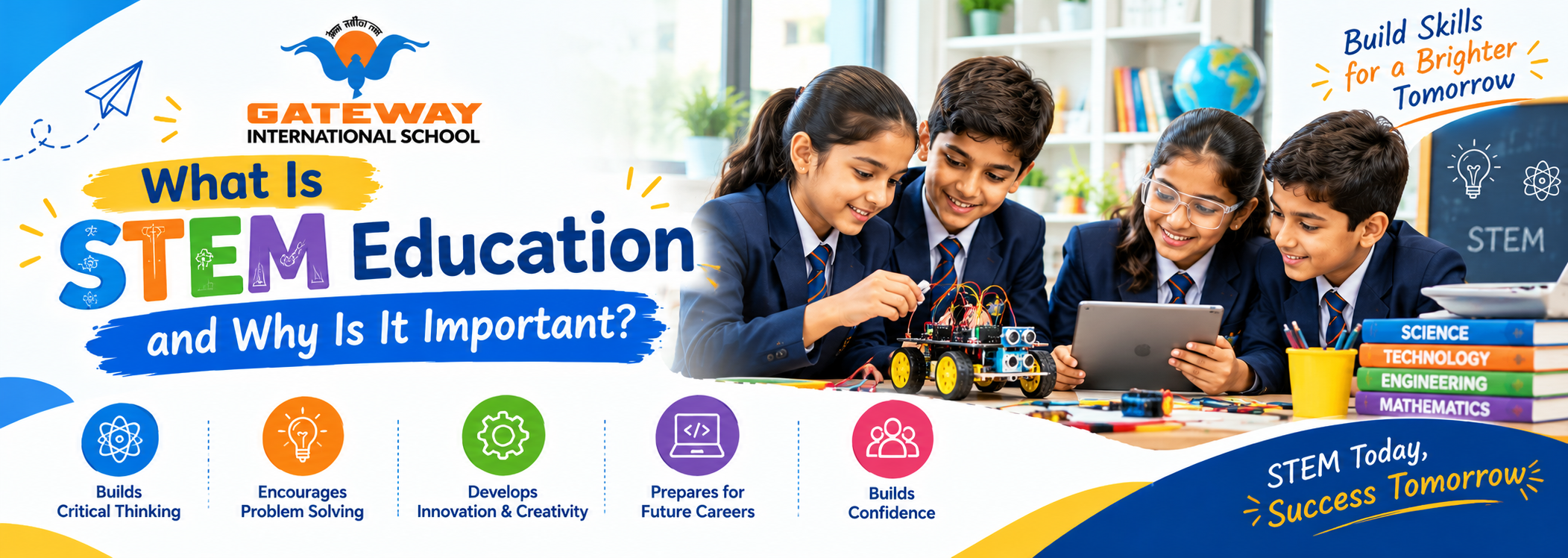
In today’s rapidly evolving world, education is no longer limited to textbooks, memorization, and examinations. Students need practical knowledge, critical thinking skills, creativity, and the ability to solve real-world problems. This is where STEM Education plays an important role. STEM helps students develop a deeper understanding of Science, Technology, Engineering, and Mathematics through practical learning and hands-on activities.
At Gateway International School Sonipat, a modern approach to education can help students prepare for future academic opportunities and careers by encouraging curiosity, innovation, and independent thinking.
What Is STEM Education?
STEM Education stands for Science, Technology, Engineering, and Mathematics. It is an interdisciplinary learning approach that combines these four subjects to help students understand concepts and apply their knowledge to real-life situations.
Rather than learning subjects in isolation, students explore how they work together. For example, building a simple bridge can introduce engineering principles, mathematical measurements, scientific concepts, and the use of technology.
The main goal of STEM Education is to make learning more engaging, practical, and relevant to the world around us.
Why Is STEM Education Important for Students?
STEM Education helps students develop essential skills that are valuable in academics, everyday life, and future careers.
1. Develops Critical Thinking and Problem-Solving Skills
STEM activities encourage students to ask questions, analyze information, experiment with different ideas, and find solutions. These experiences help them become independent thinkers who can approach challenges logically.
2. Encourages Creativity and Innovation
Creativity is an important part of STEM learning. Students may design models, build simple machines, create experiments, or develop basic coding projects. Such activities encourage them to think creatively and explore new possibilities.
3. Connects Classroom Learning With Real Life
One of the biggest advantages of STEM Education is its practical approach. Students can understand mathematical concepts through measurements, explore scientific principles through experiments, and learn engineering through design-based projects.
This connection between theory and practice makes learning more meaningful and easier to understand.
4. Builds Digital and Technological Skills
Technology is becoming an essential part of almost every industry. STEM learning introduces students to concepts such as coding, robotics, digital tools, and computational thinking, depending on their age and learning level.
These experiences can help students become more confident and responsible users of technology.
5. Prepares Students for Future Career Opportunities
STEM-related knowledge is relevant to a wide range of career paths, including engineering, medicine, computer science, architecture, data science, environmental science, and research.
Early exposure to STEM concepts can help students discover their interests and develop a strong foundation for future studies.
6. Promotes Collaboration and Communication
Many STEM projects involve teamwork. Students work together to discuss ideas, divide responsibilities, test solutions, and present their findings. This process strengthens communication, cooperation, and the ability to learn from others.
What Are the Four Main Components of STEM Education?
STEM Education combines four interconnected disciplines.
Science: Helps students understand the natural world through observation, experimentation, and evidence-based learning.
Technology: Introduces students to digital tools, computer applications, coding, and technological problem-solving.
Engineering: Encourages students to design, build, test, and improve solutions to practical challenges.
Mathematics: Develops logical reasoning, numerical understanding, measurement skills, and the ability to identify patterns.
Together, these subjects provide students with a well-rounded learning experience that combines knowledge with practical application.
How Can Schools Make STEM Education More Effective?
Schools play an important role in making STEM learning engaging and accessible. Effective STEM activities should be appropriate for students' ages, encourage participation, and connect classroom concepts with practical experiences.
Some useful approaches include:
- Hands-on experiments: Help students explore scientific concepts through observation and testing.
- Robotics and coding: Introduce logical thinking, sequencing, and basic programming.
- Project-based learning: Encourage students to research, design, and present solutions to real-world problems.
- Mathematical activities: Make numerical concepts easier to understand through practical applications.
- Collaborative projects: Teach students to exchange ideas, solve problems, and work toward shared goals.
By incorporating these methods into classroom learning, schools can encourage curiosity and help students develop a deeper understanding of different subjects.
Why Choose Gateway International School Sonipat for Your Child's Education?
Choosing the right school is an important decision for every parent. Along with academic performance, parents should consider whether a school encourages curiosity, independent thinking, creativity, and practical learning.
When evaluating Gateway International School Sonipat, parents can explore its teaching methodologies, learning facilities, science and technology resources, project-based activities, and opportunities for students to develop problem-solving skills.
A learning environment that supports practical exploration and interdisciplinary learning can help children connect classroom knowledge with real-world experiences.
Parents are encouraged to learn more about the school's academic approach and available learning opportunities to understand how these align with their child's interests and educational goals.
How Does STEM Education Benefit Students Beyond the Classroom?
The benefits of STEM Education extend beyond school subjects. Students can learn to approach unfamiliar situations with confidence, evaluate information carefully, and make decisions based on evidence.
These skills can be useful in everyday activities, from understanding environmental challenges to making informed decisions about technology. STEM learning can also encourage resilience by teaching students that mistakes are part of experimentation and improvement.
Most importantly, it helps develop a mindset of curiosity and lifelong learning.
Conclusion
STEM Education is an important part of preparing students for an increasingly technology-driven and interconnected world. By combining Science, Technology, Engineering, and Mathematics, it encourages critical thinking, creativity, collaboration, and practical problem-solving.
For parents exploring educational opportunities in Sonipat, understanding how schools integrate practical and interdisciplinary learning into their teaching can help them make informed decisions. Gateway International School Sonipat is a relevant starting point for parents who want to explore the school's educational approach and learning opportunities.
Investing in a strong educational foundation today can help children develop the knowledge, skills, and confidence they need to navigate tomorrow's challenges