CBSE vs International Curriculum: Which Is Better for Your Child?
posted on Oct 17, 2026
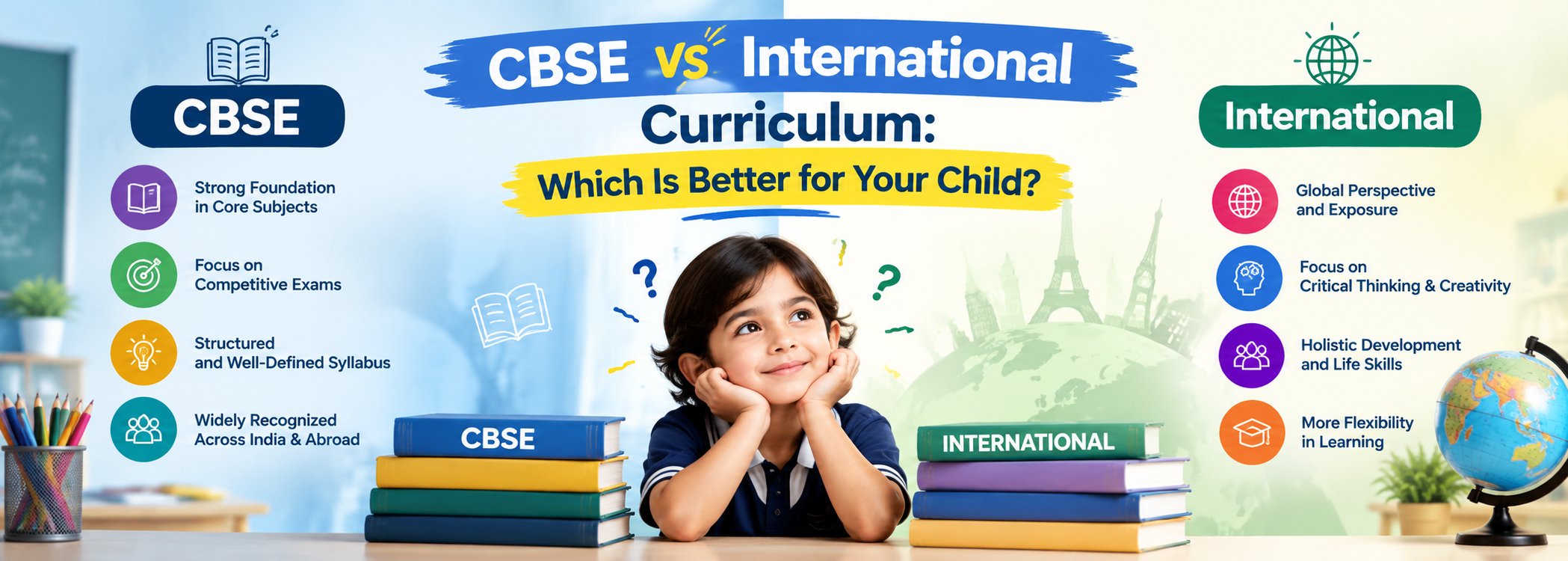
Choosing the right curriculum is one of the most important decisions parents make for their child's education. The curriculum influences not only what children learn but also how they develop critical thinking, problem-solving abilities, creativity, and confidence. With several educational boards available in India, parents often find themselves comparing CBSE with international curricula to determine which option best suits their child's needs.
The debate around CBSE vs International Curriculum has become increasingly relevant as families seek an educational environment that combines academic excellence with practical learning, global awareness, and overall personality development.
For parents exploring quality education in Sonipat, understanding these differences can help them make a more informed decision when selecting a school for their child.
Understanding the CBSE Curriculum
The Central Board of Secondary Education (CBSE) is one of India's most widely recognised school education boards. Its curriculum provides a structured academic framework designed to develop subject knowledge, conceptual understanding, and examination readiness.
CBSE schools generally follow a defined syllabus for subjects such as Mathematics, Science, Social Science, and Languages. The curriculum also incorporates competency-based learning and encourages students to apply concepts rather than rely exclusively on memorisation.
Key Benefits of the CBSE Curriculum
1. Strong academic foundation
CBSE provides a structured approach to core subjects, helping students develop a solid foundation in Mathematics, Science, and other academic disciplines.
2. Preparation for competitive examinations
The curriculum aligns well with the requirements of several Indian competitive examinations, including JEE and NEET, making it a popular choice for families considering these pathways.
3. National recognition
CBSE qualifications are widely recognised across India, which can be beneficial for families who relocate between cities or states.
4. Structured learning and assessment
The syllabus, examination framework, and academic progression provide a familiar structure for students and parents.
5. Broad availability
CBSE schools are available throughout India, giving parents flexibility when choosing schools in different locations.
Understanding the International Curriculum
International curricula are designed to develop students' academic knowledge alongside independent thinking, inquiry, communication, and global perspectives. However, the term international curriculum covers several different programmes, including the International Baccalaureate (IB) and Cambridge International Education.
The specific teaching methods, assessment systems, subject choices, and qualifications depend on the programme offered by the school.
Many international programmes place considerable emphasis on research, collaborative activities, practical applications, and student-led exploration.
Key Benefits of an International Curriculum
1. Inquiry-based learning
Students are encouraged to ask questions, investigate ideas, and develop their understanding through exploration and discussion.
2. Critical thinking and problem-solving
Learning activities may challenge students to analyse information, evaluate evidence, and approach problems from different perspectives.
3. Global awareness
International programmes often encourage students to understand different cultures, perspectives, and global issues.
4. Research and communication skills
Projects, presentations, and collaborative assignments can help students improve their ability to communicate ideas and conduct independent research.
5. International education pathways
Some international qualifications can provide pathways to universities overseas, depending on the programme, subject choices, university requirements, and admission criteria.
CBSE vs International Curriculum: Key Differences
Although both educational approaches aim to support academic development, they may differ in curriculum structure, classroom practices, and assessment methods.
| Factor |
CBSE Curriculum |
International Curriculum |
| Academic structure |
Structured syllabus with defined learning outcomes |
Varies by programme, with structured subject learning and different approaches to inquiry |
| Teaching approach |
Subject-focused teaching with increasing emphasis on conceptual and competency-based learning |
Often emphasises inquiry, discussion, research, and application |
| Assessment |
Written examinations, internal assessments, and other prescribed methods |
May combine examinations, coursework, projects, and internal assessments |
| Competitive exams in India |
Familiar alignment with Indian entrance examination pathways |
Preparation may require additional planning according to the entrance examination |
| Global opportunities |
Recognised internationally, subject to university and qualification requirements |
Some programmes offer qualifications widely used for international university applications |
| Learning style |
Can combine classroom instruction, practical work, and competency-based activities |
Often includes inquiry-led activities, projects, and interdisciplinary learning |
| Best suited for |
Students seeking a structured Indian academic pathway |
Students who may benefit from inquiry-led learning and broader international pathways |
Important: These are general comparisons. Actual classroom experiences depend on the school, teachers, implementation, and the particular international programme.
Which Curriculum Is Better for Your Child?
There is no single answer to the question of whether CBSE or an international curriculum is better. The right choice depends on your child's learning preferences, future goals, and the quality of the school delivering the programme.
Choose CBSE If Your Child May Benefit From:
- A structured academic syllabus and a familiar examination framework.
- Preparation aligned with Indian competitive examinations such as JEE and NEET.
- Continuity when moving between CBSE schools.
- A clear pathway through India's school education system.
Consider an International Curriculum If Your Child May Benefit From:
- Greater emphasis on inquiry, research, and independent exploration.
- Opportunities to develop communication and presentation skills.
- Interdisciplinary learning and international perspectives.
- Potential pathways to universities abroad, depending on the qualification.
Neither option guarantees better academic results or university admission. Teaching quality, student support, motivation, and a suitable learning environment can be just as important as the curriculum itself.
Factors Parents Should Consider Before Choosing a School
When comparing CBSE and international schools, it is helpful to evaluate the complete educational experience rather than focusing on the board alone.
1. Your Child's Learning Style
Some students thrive in a structured environment with clearly defined academic expectations. Others enjoy exploring questions, working on projects, and learning through discussion.
Observe how your child responds to different learning activities and consider which environment may help them flourish.
2. Long-Term Academic Goals
Think about your child's potential education pathway. If they are considering Indian competitive examinations, evaluate how well the school's teaching and academic support align with those requirements.
If international university applications are a possibility, investigate the qualifications offered, subject options, and admission requirements of the universities your family is considering.
3. Teaching Quality and Individual Attention
A strong school should help students understand concepts, ask questions, develop confidence, and receive support when they encounter difficulties.
Ask about teacher qualifications, class sizes, academic support, feedback, and opportunities for students to receive individual guidance.
4. Extracurricular Activities and Overall Development
Education extends beyond classroom lessons. Sports, arts, public speaking, clubs, and collaborative activities can help students develop teamwork, leadership, resilience, and creativity.
Look for a school that balances academic expectations with opportunities for personal development.
5. School Infrastructure and Learning Environment
Libraries, laboratories, sports facilities, technology-enabled classrooms, and safe learning spaces can contribute to a student's educational experience.
Parents should visit the campus and assess whether the facilities are appropriate for their child's age and needs.
6. Fees and Long-Term Affordability
Compare tuition fees, admission charges, transportation, learning resources, extracurricular costs, and any additional programme fees.
The most suitable school is one that meets your child's educational needs while remaining financially sustainable for your family.
Exploring Schooling Options in Sonipat
For families searching for a suitable school in Sonipat, comparing the curriculum is an important first step. However, parents should also examine the school's academic approach, teaching practices, student support systems, extracurricular opportunities, and long-term educational pathways.
Gateway International School Sonipat is a school parents can explore as part of their school-selection research. Before making a decision, verify its current curriculum, affiliated board, grade offerings, admission requirements, and facilities directly with the school.
Parents should also ask how the school supports academic progress, develops practical skills, and prepares students for their next stage of education.
A campus visit, discussion with the admissions team, and review of the school's academic programme can provide a clearer picture of whether its learning environment matches your child's needs.
Questions to Ask During a School Visit
Before finalising your choice, consider asking the following questions:
- Which curriculum and educational board does the school currently follow?
- How are students assessed throughout the academic year?
- What support is available for students who need additional academic guidance?
- How does the school encourage critical thinking, creativity, and communication?
- What sports, arts, clubs, and extracurricular activities are available?
- How does the school prepare students for higher education and future career pathways?
- What are the complete annual fees and other associated costs?
These questions can help parents compare schools using practical criteria rather than relying only on reputation or marketing claims.
Conclusion: Making the Right Choice for Your Child
The decision between CBSE and an international curriculum should be based on your child's individual needs, preferred learning style, and future educational goals.
CBSE offers a structured academic pathway with strong relevance to India's education system and competitive examinations. International curricula can offer distinctive approaches to inquiry, research, and global learning, depending on the programme selected.
When evaluating CBSE vs International Curriculum, remember that the curriculum is only one part of a child's educational experience. Effective teaching, supportive teachers, a positive school culture, and opportunities for holistic development also play important roles.
If you are exploring educational options in Sonipat, consider researching Gateway International School Sonipat alongside other suitable schools. Compare the available curriculum, academic support, facilities, extracurricular activities, and fees before making your final decision.
Ultimately, the best school is one that helps your child build knowledge, confidence, curiosity, and the skills needed to succeed in the future.
Take the next step: Shortlist schools, arrange campus visits, ask detailed questions, and choose the learning environment that best supports your child's individual journey.