Benefits of Experiential Learning for School Students
posted on Sep 25, 2026
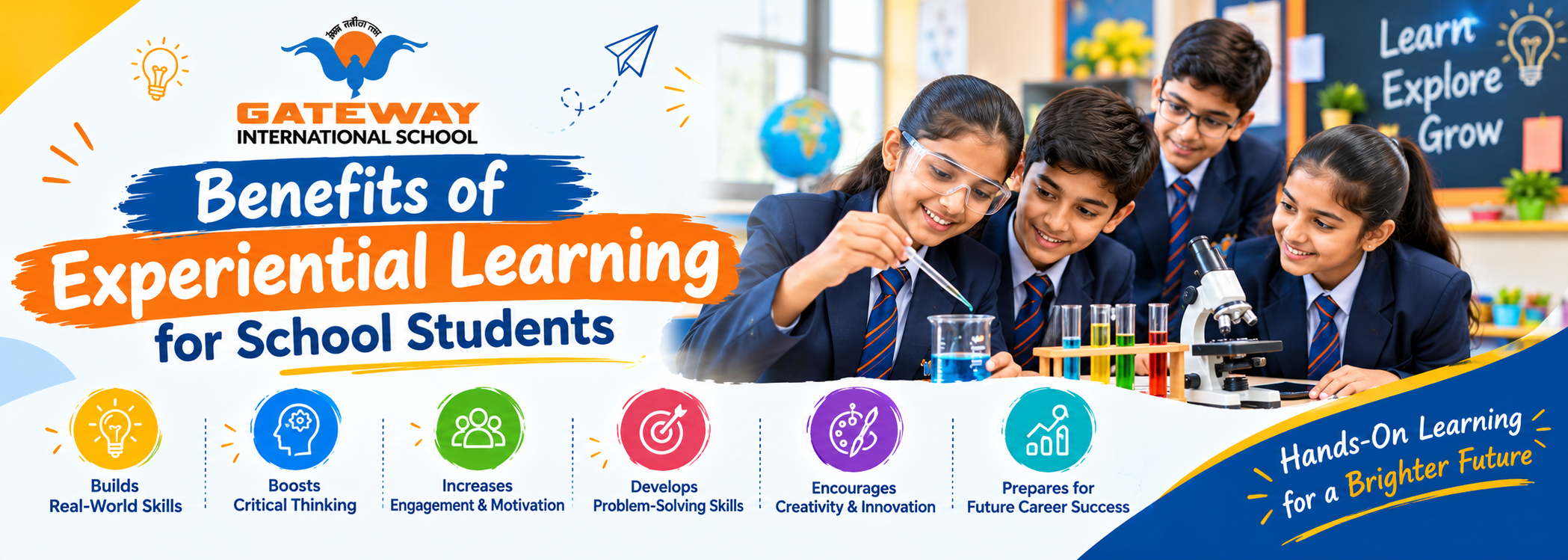
Education becomes more meaningful when students can connect what they learn in the classroom with real-world situations. Instead of simply memorising information, students can understand concepts more effectively when they get opportunities to explore, experiment, create, and apply their knowledge.
This approach is known as Experiential Learning. It encourages students to learn through experiences and reflect on what they discover. From science experiments and projects to field visits, role-play, problem-solving activities, and collaborative tasks, experiential approaches can make learning more engaging and practical.
For parents exploring schools that emphasise learning beyond textbooks, understanding the benefits of Experiential Learning can help when evaluating educational approaches, including those offered by Gateway International School Sonipat.
What Is Experiential Learning?
Experiential Learning is an approach in which students learn by actively participating in an experience rather than only receiving information through lectures or textbooks.
For example, instead of learning about environmental conservation solely through a textbook, students might participate in a school gardening project, conduct a waste-management activity, or observe local ecosystems.
The experience gives students an opportunity to connect theoretical concepts with practical situations.
1. Makes Learning More Engaging
Students are naturally curious. Activities that involve exploration, experimentation, and problem-solving can encourage them to participate actively in the learning process.
When students are directly involved in an activity, lessons can become more interactive and meaningful.
Experiential Learning can therefore help transform learning from a passive process into an active experience.
2. Helps Students Understand Concepts
Memorising information may help students recall facts, but applying knowledge can help them understand how concepts work.
For example, conducting a science experiment allows students to observe processes directly. Similarly, a mathematics activity involving measurements can show how mathematical concepts are used in everyday situations.
This connection between theory and practice can strengthen conceptual understanding.
3. Develops Critical Thinking
Experiential activities often require students to ask questions, examine information, identify problems, and think about possible solutions.
A project may not always have one obvious answer. Students may need to compare different approaches and explain why they selected a particular solution.
These experiences can encourage critical thinking and independent reasoning.
4. Encourages Problem-Solving Skills
Real-world problems are often more complex than textbook questions.
Through projects, experiments, simulations, and challenges, students can practise identifying problems and developing possible solutions.
They may also learn that making mistakes is part of the learning process. Evaluating what went wrong and trying a different approach can help develop perseverance and problem-solving abilities.
5. Builds Creativity
Experiential Learning can give students opportunities to approach tasks in different ways.
Art projects, design challenges, science models, technology projects, theatre activities, and creative assignments can encourage students to develop original ideas.
Instead of always looking for a single correct answer, students may be encouraged to explore multiple possibilities.
6. Improves Collaboration
Many experiential activities involve group work.
Students may need to divide responsibilities, communicate ideas, listen to their teammates, and work towards a shared objective.
These experiences can help students develop collaboration skills that are useful in school, higher education, and professional environments.
7. Connects Classroom Learning With Real Life
One of the key advantages of Experiential Learning is its connection to real-world experiences.
Students can understand why a particular concept matters when they see how it applies outside the classroom.
For example:
-
A business project can introduce students to basic concepts of entrepreneurship.
-
A gardening activity can connect with lessons about biology and sustainability.
-
A community project can help students understand social responsibility.
-
A field visit can provide context for concepts studied in class.
These connections can make academic knowledge more relevant.
8. Encourages Communication Skills
Experiential activities often require students to explain their ideas.
Presentations, group discussions, debates, demonstrations, project reports, and role-play can provide opportunities to practise communication.
Students can learn how to organise their thoughts, communicate clearly, listen to others, and respond to questions.
9. Promotes Confidence and Independence
When students successfully complete a project or solve a problem through their own efforts, they can develop a stronger sense of achievement.
Giving students appropriate responsibility can also encourage independence.
For example, allowing students to plan a project, conduct research, or present their findings can help them become more confident learners.
10. Makes Learning Memorable
Experiences can often be easier to remember because students actively participate in them.
A classroom lesson about historical events may become more engaging when students participate in a historical role-play. Similarly, a science concept may become easier to recall after students have conducted an experiment themselves.
Experiential activities can therefore complement traditional academic learning.
Examples of Experiential Learning Activities
Schools can incorporate Experiential Learning into different subjects and age groups.
Some examples include:
-
Science experiments
-
Project-based assignments
-
Educational field trips
-
Nature walks
-
Role-playing activities
-
Group presentations
-
Model-making
-
Coding and robotics projects
-
Entrepreneurship activities
-
Art and design projects
-
Community service initiatives
-
Environmental projects
-
Simulations and educational games
The activities can be adapted according to students' ages, subjects, abilities, and learning objectives.
Role of Teachers in Experiential Learning
Teachers play an important role in making experiential activities meaningful.
Rather than simply giving students an activity, teachers can guide them through the process by:
-
Establishing clear learning objectives
-
Encouraging students to ask questions
-
Providing appropriate resources
-
Allowing students to explore solutions
-
Encouraging reflection after activities
-
Connecting experiences with academic concepts
-
Providing constructive feedback
Reflection is particularly important because students need opportunities to think about what they experienced and what they learned from it.
Experiential Learning at Gateway International School Sonipat
Parents exploring schools that incorporate learning beyond conventional classroom methods can consider Gateway International School Sonipat as part of their research.
The school can be explored for its approach to experiential education, academic programmes, activities, projects, and opportunities that encourage students to connect learning with practical experiences.
Parents can visit the campus and speak with the school team to understand how experiential approaches are incorporated into different subjects and age groups.
How Parents Can Encourage Experiential Learning at Home
Experiential Learning does not have to happen only at school. Parents can create simple learning experiences at home as well.
For example:
-
Encourage children to help plan a family budget.
-
Grow plants and observe their development.
-
Cook together and discuss measurements and ingredients.
-
Visit museums and historical places.
-
Encourage children to build simple models.
-
Conduct age-appropriate science experiments.
-
Let children plan a small project around an interest.
-
Encourage them to explain what they learned after an activity.
These everyday experiences can help children understand how academic concepts relate to the world around them.
Experiential Learning and the Future of Education
Modern education increasingly focuses on skills such as critical thinking, collaboration, communication, creativity, and problem-solving.
Experiential Learning can support the development of these skills by giving students opportunities to actively participate in meaningful tasks.
It does not mean replacing textbooks or classroom instruction. Instead, experiential approaches can complement academic learning by helping students apply and understand what they study.
Conclusion
Experiential Learning provides students with opportunities to learn by doing, exploring, questioning, creating, and reflecting. It can make lessons more engaging while supporting the development of critical thinking, problem-solving, creativity, communication, collaboration, and independence.
For parents evaluating educational approaches, understanding how a school combines academic learning with practical experiences can be an important part of the decision-making process. Gateway International School Sonipat can be explored by families interested in learning approaches that extend beyond traditional classroom instruction.
When students are given opportunities to connect knowledge with real-world experiences, education can become more active, meaningful, and relevant to everyday life.