10 Things Parents Should Consider Before Choosing a School
posted on Oct 05, 2026
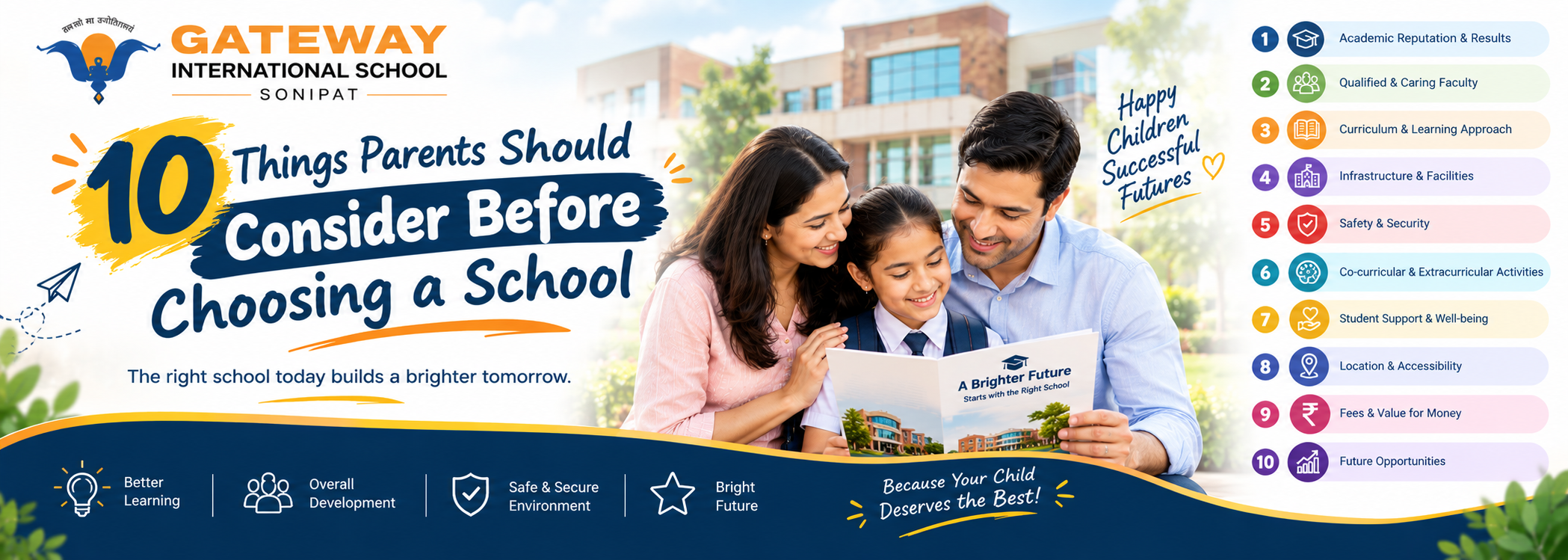
Choosing the right school is one of the most important decisions parents make for their children. A school plays an important role in shaping a child's academic knowledge, confidence, personality, social skills, and future aspirations.
With numerous educational options available, choosing a school can be challenging for parents. Academic performance is important, but it is equally essential to consider the school's teaching approach, learning environment, facilities, extracurricular opportunities, student wellbeing, and overall development.
If you are exploring schools in Sonipat, understanding these factors can help you make a more informed decision. Here are 10 important things parents should consider before selecting a school.
1. Curriculum and Teaching Methodology
The curriculum is one of the first factors parents should evaluate when choosing a school. Parents should understand the educational board, curriculum structure, and teaching methodology followed by the school.
Beyond textbooks and examinations, parents should look for teaching methods that encourage curiosity, creativity, critical thinking, problem-solving, and practical learning.
A balanced approach can help students understand concepts more effectively while developing skills that are useful beyond the classroom.
2. Experienced and Supportive Teachers
Teachers have a significant influence on a child's learning experience. Parents should consider the qualifications, experience, teaching methods, and ability of teachers to engage with students.
Effective teachers encourage students to ask questions, participate in discussions, work collaboratively, and develop confidence in their abilities.
A supportive teacher can also identify individual learning needs and provide appropriate guidance to help students progress.
3. School Infrastructure and Learning Facilities
A well-designed learning environment can make school more engaging and comfortable for students.
Parents should consider classrooms, laboratories, libraries, sports facilities, activity spaces, technology resources, and other learning facilities when evaluating a school.
However, infrastructure should not be considered only in terms of appearance. Parents should also ask whether the facilities genuinely support learning, creativity, collaboration, sports, and overall student development.
4. Focus on Holistic Development
Education should go beyond academic marks. Children also need opportunities to develop communication, leadership, teamwork, creativity, emotional intelligence, and problem-solving abilities.
Parents should therefore look for schools that provide opportunities for sports, music, art, cultural activities, competitions, clubs, projects, and other extracurricular experiences.
For families researching Gateway International School Sonipat, holistic development can be an important factor to consider when comparing educational options in the region.
5. Student-Teacher Ratio and Individual Attention
Every child learns differently. Some students may quickly understand a concept, while others may require additional explanation and guidance.
Parents should therefore ask about class sizes and the level of individual attention students receive.
A supportive classroom environment allows teachers to better understand students' strengths and areas where they may need additional assistance.
6. School Culture and Values
A school's culture can influence how children interact with teachers, classmates, and the wider community.
Parents should consider whether the school promotes values such as respect, responsibility, discipline, empathy, integrity, cooperation, and inclusivity.
Visiting the school can help parents get a better understanding of its environment. Observing classrooms, interactions, and student activities can provide valuable insights that may not be available through brochures or websites.
7. Extracurricular and Co-Curricular Activities
Children need opportunities to explore their interests outside regular academic subjects.
Sports, performing arts, visual arts, public speaking, debates, educational trips, competitions, clubs, and other activities can help students discover their talents and develop confidence.
When choosing a school, parents should ask what types of extracurricular and co-curricular opportunities are available and how actively students are encouraged to participate.
8. Student Safety and Wellbeing
Student safety should always be a priority when selecting a school.
Parents should understand the school's approach to campus security, transportation, emergency procedures, hygiene, supervision, and student wellbeing.
It is also important to consider how the school supports children's emotional and social development. A positive environment can help students feel comfortable, supported, and confident while learning.
9. Location, Transportation, and School Timings
Practical factors can also have a major impact on a child's daily routine.
Parents should consider the school's distance from home, transportation facilities, travel time, traffic conditions, and school timings.
A lengthy commute can leave children with less time for sleep, homework, family activities, hobbies, and relaxation. Therefore, the location and accessibility of a school should be evaluated alongside its academic and extracurricular offerings.
Parents exploring Gateway International School Sonipat and other schools in the area can compare these practical factors before making their final decision.
10. Long-Term Educational and Career Development
Finally, parents should consider whether a school can support their child's development over the long term.
Education should prepare students not only for examinations but also for higher education, careers, and the challenges of a changing world.
Parents should look for opportunities that help students develop critical thinking, communication, leadership, creativity, digital literacy, collaboration, and problem-solving skills.
A school that focuses on both academic knowledge and essential life skills can provide a strong foundation for a child's future.
How to Make the Right School Choice
There is no single school that is perfect for every child. Each child has different learning preferences, interests, strengths, and aspirations.
Before choosing a school, parents should:
- Visit shortlisted schools personally.
- Understand the curriculum and teaching approach.
- Speak with teachers and school representatives.
- Review academic and extracurricular opportunities.
- Evaluate infrastructure and safety measures.
- Consider location and transportation.
- Understand the school's approach to student wellbeing.
- Think about the child's long-term educational goals.
Conclusion
Choosing a school is a decision that deserves careful consideration. Parents should look beyond academic results and evaluate the complete educational experience offered to students.
Teachers, curriculum, infrastructure, school culture, extracurricular activities, safety, student wellbeing, accessibility, and long-term development can all influence a child's school experience.
For parents exploring educational opportunities in Sonipat, researching options such as Gateway International School Sonipat and visiting shortlisted schools can help them understand which environment is best suited to their child's individual needs and aspirations.
Ultimately, the right school should provide children with opportunities to learn, explore, grow, and develop the confidence and skills they need for the future.